
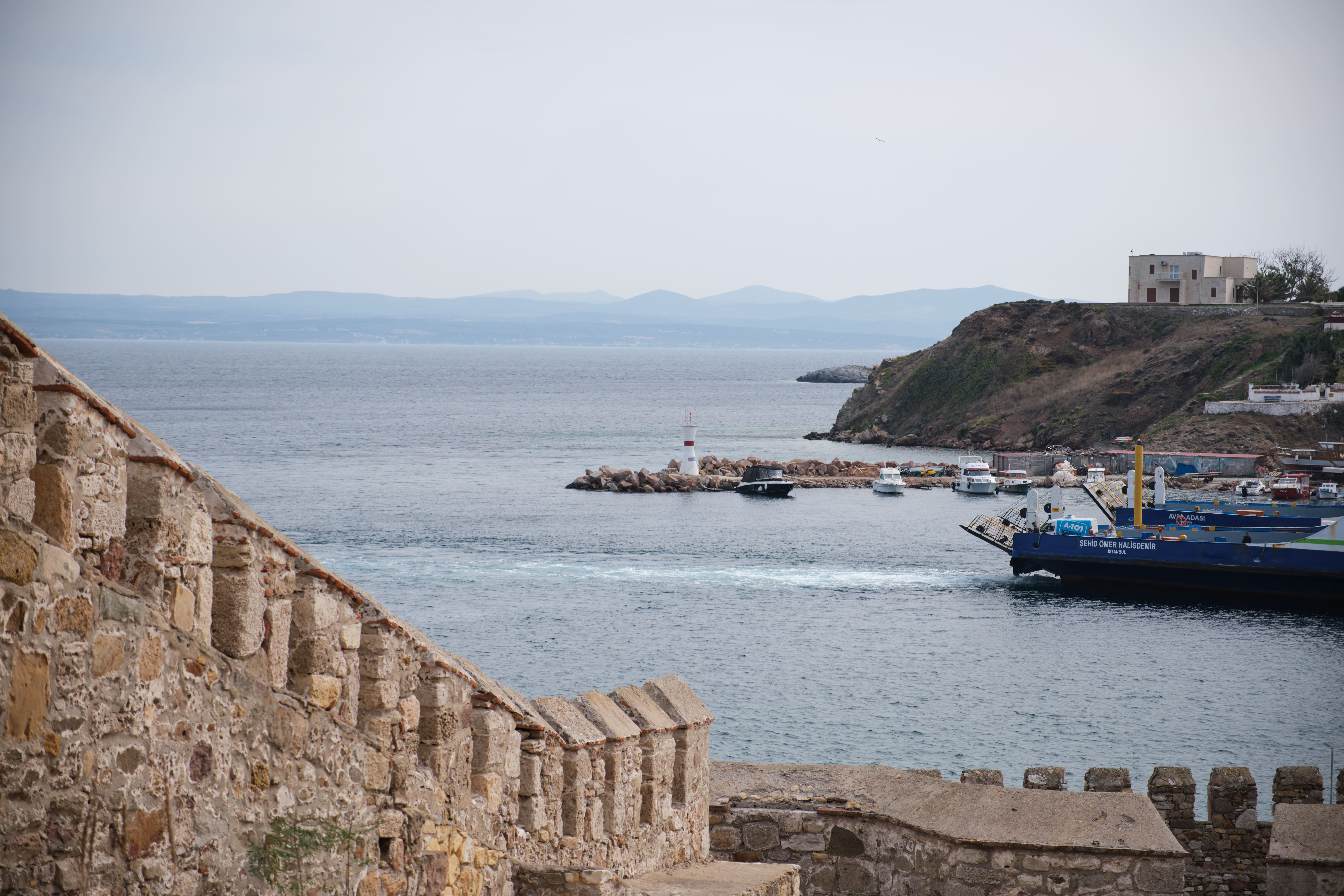
Apparently, the island’s harbour is being expanded. Or perhaps the harbour is not being expanded, only the breakwaters extended. News reports call it the “Bozcaada Harbour Yacht Berthing Quay Project”. To my mind, as far as my concerns go, all these descriptions amount to the same thing. Beyond the transport of hundreds of thousands of tonnes of stone (around six hundred thousand, they say); the effects on the ecosystem and seabed; the passage of enormous trucks; the noise and dust; and the difficulties that small tourism operators, guesthouses and restaurants, all of whom will be badly affected, will have to bear, my concern is this: the currents that keep Bozcaada Harbour, one of the world’s most special, distinctive and clean harbours (despite the GESTAŞ ferries stirring up its bottom every hour, especially in summer), so clean may be damaged or cut off. The seabed can repair itself, but if the current that may have kept the harbour clean for thousands of years is cut off or disrupted, it cannot be repaired. Before taking such an enormous step, have scientists in Çanakkale and Balıkesir, the island’s elders and fishers, and texts and sources about the island going all the way back to ancient mythology been consulted? I doubt it. Has the local administration, the municipality, been consulted; have its views, suggestions and concerns been heard and addressed? I doubt it.
On an island known and admired for being small and for not growing, I must be too dim to understand any notion of “growth”. That is why I do not understand why the harbour is being enlarged, either. Apparently, the boats do not fit. Then let them not fit. The ferries cannot operate, they say. Is that not like the prestige and pride of a restaurant turning customers away because it is full? Our harbour is full. Another harbour, then. Back when my neighbour Captain Ayhan was active, these ferries could come and go in any weather. It is also well known that a significant part of the disruption to these crossings has to do with the problems caused by Geyikli Pier.
I can think of almost no verb worse than “to grow”. Perhaps “to die” is worse. The way I, and the students you see on the island every October, look at life is reflected in the motto of the Bozcaada International Festival of Ecological Documentary, which we have organised in solidarity with Bozcaada Municipality and with you for thirteen years:
Local, Small, Slow.
Please look at the things and places that have grown: Alanya, Kuşadası, Çeşme, Istanbul… To my mind, what has actually grown there is stress, unhappiness, crime, noise and a poor-quality, hurried way of life. I look at myself first and say I wish I had not grown up. Many of the island’s defining qualities, the things that make it so beautiful and special, are hidden in the words “local, small and slow”. Cruise tourism and/or mass tourism, and therefore a very large marina, will ultimately bring no good; they will bring pollution, drugs, unjust profits and crime. Instead of summer tourism that grows more intense, wilder and poorer in quality each year, and that does not fit the island’s traditional character, what we ought to work on is another kind of tourism, from October to March, built around classical music, theatre, cinema, sport and scientific meetings — if something absolutely must be developed. Look at the statistics: what increases on the island every year? Happiness? I do not think so; noise, waste, quarrels, unhappiness. So we have far more pressing problems than a breakwater. Thirty more yachts berthing in the harbour will not solve them. We can solve these problems through solidarity, through a different, calmer, locally grounded outlook based on solidarity. (God willing.)
To my mind, the issues Bozcaada needs to address are quite different. Construction on the island and the removal of structures known as tiny houses, using water more sparingly, plastics, recycling and the enormous pressure of summer tourism on the island are already very important matters that ought to be considered first. Using solar energy to heat homes with the summer sun, using wind energy… With its small scale, Bozcaada could be one of the places best suited to a transition from harmful oil- and coal-based fuels to solar and wind energy. Would that not be a truly revolutionary approach?
In the coming years, when the municipality will be forced to limit how often towels and sheets are changed, how lawns are watered, and every kind of water use, including in agriculture (this will happen across Türkiye and, unfortunately, around the world; it is not a situation unique to us), growth — growth of any kind — must be a step taken with great care.